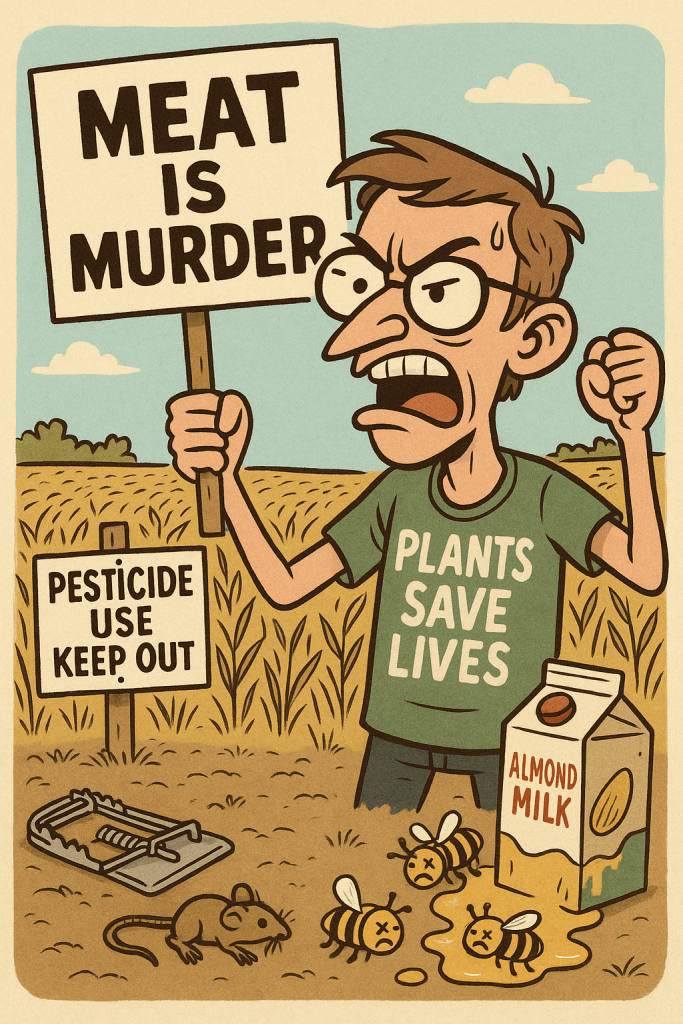
Let’s get something straight from the jump: I’m not here to bash vegans. If someone chooses a plant-based lifestyle for health, environmental, or ethical reasons—more power to them. Live your values. Respect. But what I do have a problem with are the self-righteous extremists who scream from their tofu-scented soapboxes that meat-eaters are murderers while conveniently ignoring the blood on their own kale-stained hands.
Sound harsh? Maybe. But truth often is.
Because here’s the uncomfortable reality: the agriculture industry—the very engine behind all those grains, fruits, and vegetables that form the backbone of a vegan diet—is responsible for killing billions of animals every year. Not for meat. Not for leather. Not for fur. For crops. For soy. For almonds. For wheat. For tofu.
Let’s talk numbers. According to a 2003 study published in the journal Animal Welfare, it’s estimated that over 55% of all animal deaths caused by agriculture in Australia came from plant crop production, not animal farming [1]. That’s things like mice, rabbits, snakes, birds, and insects slaughtered en masse by harvesting equipment or poisoned by pesticides. In fact, a field of grain is a deathtrap for small animals.
But the numbers don’t stop there. A study from the University of Oregon estimated that a diet of plants still results in more than 15 times more animal deaths per hectare than a pasture-raised beef diet [2]. In other words, grass-fed beef may actually cause fewer animal deaths than a bowl of lentils grown on a commercial farm. Let that sink in.
Now, to be clear, this isn’t about saying meat is morally superior to vegetables. It’s about pulling the wool out of our eyes and facing the full picture. The ethical high ground extremist vegans claim to stand on? It’s built on a foundation of field mice skulls and insecticide residue.
Here’s another kicker: not all vegan food is “clean.” Consider almond milk, the darling of dairy-free coffee drinkers. Almond farming, especially in places like California, devastates honeybee populations through mass pollination practices that literally work bees to death. Commercial beekeeping for almond farms has been linked to widespread colony collapse [3]. Yet, I don’t see many vegan influencers boycotting almond milk or calling for systemic reform there.
Same with soy. The monoculture of soybeans—largely driven by both vegan and livestock feed markets—is wiping out biodiversity across South America, contributing to deforestation, water pollution, and habitat loss on a massive scale [4]. Irony, thy name is tofu.
But what’s the reaction when these facts are brought up in conversation? Crickets. Or worse, smug deflections like, “Well, at least I’m not eating animals.” No, you’re not. You’re just supporting an industry that kills them by the billions—quietly, indirectly, and under the radar.
Now, if you’re a vegan who acknowledges this, who makes conscious choices to support regenerative agriculture, local farming, or wildlife-friendly practices—again, respect. Truly. But if you’re the type to shame others while pretending your quinoa salad doesn’t drip with collateral damage, you might want to sit this one out.
We don’t need more purity tests. We need honesty. And nuance. And maybe a little humility.
So what’s the takeaway here? Whether you’re a carnivore, omnivore, vegetarian, or vegan, the real battle isn’t each other. It’s factory farming, monoculture, and the blind consumerism that feeds the machine. That’s where the real damage is done.
Call to Action:
Start asking where your food comes from—all of your food. Support local farms. Choose regenerative practices when you can. Be willing to acknowledge that no diet is 100% guilt-free, and let that awareness guide you toward better choices—not louder judgment.
Because the truth is: we all have blood on our plates. The question is, what are we doing about it?
References:
Lamey, A. (2007). Food Fight: The Case for Ethical Vegetarianism. Journal of Animal Law, 3(1).
Davis, S.L. (2003). The Least Harm Principle May Require that Humans Consume a Diet Containing Large Herbivores, Not a Vegan Diet. Journal of Agricultural and Environmental Ethics, 16(4), 387–394.
United States Department of Agriculture. (2020). Honey Bee Colonies. https://www.nass.usda.gov
WWF. (2021). The Impact of Soy: A Growing Threat. https://www.worldwildlife.org
Pollan, M. (2006). The Omnivore’s Dilemma: A Natural History of Four Meals. Penguin Press.
Broom, D.M. (2012). Sentience and Animal Welfare. CABI Publishing.
Trewavas, A. (2001) Urban Myths of Organic Farming. Nature, 410(6834), 409–410.

 Past The Static